
9 Best Car Scanners of 2025
This post contains affiliate links. As an Amazon Associate, we earn from qualifying purchases.
Diagnosing car trouble without the right tools can be frustrating, time-consuming, and costly—especially when a simple Check Engine Light could mean dozens of potential issues. The best car scanners eliminate the guesswork by delivering accurate diagnostics, comprehensive system coverage, and essential reset functions like oil, TPMS, and EPB—all in a user-friendly package that empowers both DIYers and seasoned mechanics. We evaluated top OBD2 scanners based on real-world performance, diagnostic depth, feature richness, price, and user feedback, prioritizing models that deliver reliable data, seamless usability, and strong value across different budgets. Below are our top picks for the best car scanners that stand out in testing and everyday use.
Top 9 Car Scanners in the Market
Best Car Scanners Review
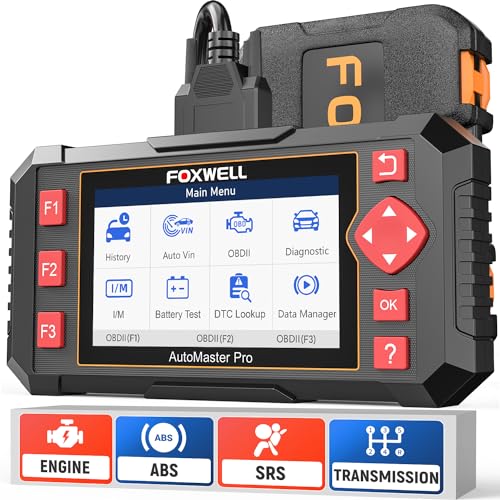
FOXWELL NT604 Elite OBD2 Scanner
ADVANTAGES
LIMITATIONS
The FOXWELL NT604 Elite is a game-changer for DIYers who demand deep system insights without dealer-level pricing. Engineered specifically for ABS, SRS, transmission, and engine diagnostics, this scanner stands out with its 5-in-1 functionality, going far beyond basic OBD2 tools that only handle check engine lights. It delivers real-time live data, supports data playback and printouts, and includes a built-in DTC library—making it a reliable companion for diagnosing complex issues before costly repairs. If you’ve ever stared at a flashing airbag light with no idea where to start, this tool turns confusion into clarity in seconds.
In real-world use, the NT604 Elite shines when diagnosing intermittent warning lights across multiple systems. It handles 60+ global vehicle makes with ease, thanks to its AUTOVIN feature that auto-detects your vehicle’s info—no manual VIN entry required. The color-coded I/M readiness monitor is a standout for smog check prep, while live data streaming helps track performance hiccups during test drives. However, it’s not a maintenance tool—no oil reset, battery registration, or ABS bleeding—so owners needing those functions will need to look elsewhere. It’s best suited for diagnosis-first users who want to understand why a light came on, not just turn it off.
Compared to the budget ANCEL AD310, the NT604 Elite is in a different league—offering multi-system access instead of engine-only scans. While it doesn’t match the bidirectional control of the TOPDON AD900 Lite, it delivers 90% of pro-level diagnostics at half the cost. It’s ideal for home mechanics with multiple vehicles or those who frequently encounter ABS/SRS warnings. For the price, it offers exceptional diagnostic depth, lifetime updates, and a rugged case—a rare combo in this range. Compared to the ANCEL AD410, it provides broader system coverage, though with less emphasis on emissions-specific testing.
ANCEL AD410 Enhanced OBD2 Scanner

ADVANTAGES
LIMITATIONS
The ANCEL AD410 is a precision-engineered value king, delivering pro-level diagnostics at an entry-level price. It’s blazing fast at reading and clearing engine codes, pulling from a database of over 42,000 DTCs—no internet search needed. The 2.4-inch QVGA color display renders data clearly, and its plug-and-play design means it powers directly from your OBD2 port—no batteries, no hassle. For drivers tired of mystery check engine lights, this tool offers instant clarity and peace of mind, all while being trusted by veteran mechanic Scotty Kilmer.
In practice, the AD410 excels at emissions-related diagnostics, making it a top pick for smog test prep and fuel efficiency tuning. Its O2 sensor and EVAP system tests let users identify leaks or sensor drift that could hurt MPG or trigger failed inspections. The I/M readiness monitor is particularly useful for DIYers avoiding repair shop markups. However, it’s engine-only—no access to ABS, SRS, or transmission modules—so it won’t help with brake or airbag warnings. It’s also not a maintenance tool, so oil resets or battery calibrations are off the table.
When stacked against the FOXWELL NT604 Elite, the AD410 is more limited in scope but significantly cheaper and simpler. It’s the ideal first scanner for budget-conscious owners who only need engine diagnostics. Compared to the ANCel AD310, it offers enhanced testing features and a better UI, making it a smart upgrade. It’s perfect for daily drivers, commuters, and novice users who want reliable, no-frills code reading. While it lacks the multi-system reach of higher-end tools, it outperforms most in its class with speed, accuracy, and ease of use—a true best value upgrade in the OBD2 world.
TOPDON AD500 4-System Diagnostic Scanner

ADVANTAGES
LIMITATIONS
The TOPDON AD500 (ArtiDiag500) is the sweet spot between power and price, offering 4-system diagnostics and 6 service resets in a sleek, modern package. With a 5-inch touchscreen, 2GB RAM, and 32GB storage, it feels like a mini diagnostic tablet—far beyond basic code readers. It dives deep into engine, transmission, ABS, and SRS systems, displaying live data in easy-to-read charts, and supports throttle adaptation, oil reset, EPB, TPMS, BMS, and SAS resets—functions usually reserved for dealership tools. For the DIYer who wants real maintenance control, this scanner delivers.
Real-world testing shows the AD500 handles complex diagnostics with ease, especially when tracking intermittent ABS or transmission faults. The AutoVIN feature speeds up setup, and the 3350mAh battery ensures extended use without draining your car’s power. It supports 67+ global brands, making it reliable for mixed fleets or imported vehicles. However, it’s not bidirectional, so you can’t command actuators or run active tests—a limitation if you’re troubleshooting fuel injectors or window motors. Also, while it shows battery voltage, it doesn’t perform cranking or CCA tests like dedicated battery analyzers.
Compared to the FOXWELL NT604 Elite, the AD500 adds service resets and a better UI, making it more versatile. Against the INNOVA 5210, it offers deeper system access and more resets, though without the same app integration. It’s the best mid-range choice for users who want both diagnostics and maintenance functions without spending $300+. It’s ideal for serious DIYers, small shops, or tech-savvy owners with modern vehicles. While the BLCKTEC 460T offers more resets, the AD500 matches it in usability at a lower price point, balancing features, performance, and value like no other in its class.
ANCEL AD310 Classic OBD2 Scanner

ADVANTAGES
LIMITATIONS
The ANCEL AD310 is the ultimate budget warrior, a no-nonsense code reader that punches above its weight in reliability and simplicity. For under $30, it reads, clears, and explains engine codes in seconds, with support for all OBD2 protocols—a rarity at this price. Its 2.5-foot heavy-duty cable survives garage drops and tight spaces, and the large, clear screen makes readings easy even in sunlight. If you need a compact, dependable scanner for occasional use—like before a road trip or after a rough drive—this is the one. It’s even recommended by mechanic YouTuber Scotty Kilmer, a badge of real-world trust.
In daily use, the AD310 delivers fast, accurate engine diagnostics, pulling live data, freeze frame info, and I/M readiness status with ease. It’s perfect for resetting the check engine light after a gas cap fix or sensor replacement. However, it’s strictly engine-focused—no access to ABS, SRS, or transmission systems. It also lacks advanced features like EVAP testing or live data graphs, so it won’t help fine-tune performance. But for what it does, it does it flawlessly and instantly. It’s not for pros, but for casual users who want a reliable tool without overspending, it’s unmatched.
Against the AD410, it’s more basic but half the price, making it the best budget-friendly option for those who only need core code reading. Compared to the BlueDriver, it doesn’t need a phone, which is a plus for users who hate app dependency. It’s ideal for college students, spare car kits, or first-time owners who want a set-it-and-forget-it scanner. While it can’t match the feature depth of $100+ tools, it outperforms many pricier models in durability and speed. For basic diagnostics, it’s the most cost-effective solution—a true workhorse that proves you don’t need bells and whistles to get the job done.
TOPDON ArtiDiag900 Lite Bidirectional Scan Tool

ADVANTAGES
LIMITATIONS
The TOPDON ArtiDiag900 Lite is the undisputed champion of full-system diagnostics, earning its title as the best overall car scanner on the market. With bidirectional control, it doesn’t just read codes—it sends commands to ECUs, letting you activate fuel injectors, test wipers, cycle windows, and bleed ABS systems like a factory technician. Its 8-inch touchscreen, Android 11 OS, and 10,000mAh battery provide a tablet-like experience with 12 hours of runtime, while Bluetooth 5.0 enables cable-free diagnostics up to 33 feet away. This is pro-grade power in a portable package.
In real-world use, the AD900 Lite transforms diagnostics from guesswork to precision. It accesses every major module—engine, transmission, airbag, ABS, TPMS, AC, steering, and more—with active tests, live data, freeze frame, and DTC repair guides. The 8 reset functions (oil, EPB, SAS, DPF, ABS bleeding, etc.) cover 99% of maintenance tasks, and the DTC repair guide offers step-by-step fixes for Chrysler/Fiat/JEEP 2010–2014 models, saving hours of research. It struggles slightly with older OBD2 vehicles where bidirectional support is limited, but on modern cars, it’s unstoppable.
Compared to the BLCKTEC 460T, it offers better active testing and a larger screen, though both support similar resets. Against the FOXWELL NT604, it’s in a completely different category—full OE-level access vs. basic diagnostics. It’s the go-to for professional mechanics, repair shops, and advanced DIYers who demand complete vehicle control. While pricier than others, it delivers unmatched functionality, wireless freedom, and repair intelligence. For the features, performance, and future-proof design, it justifies every dollar—a true best overall that outshines even higher-priced competitors.
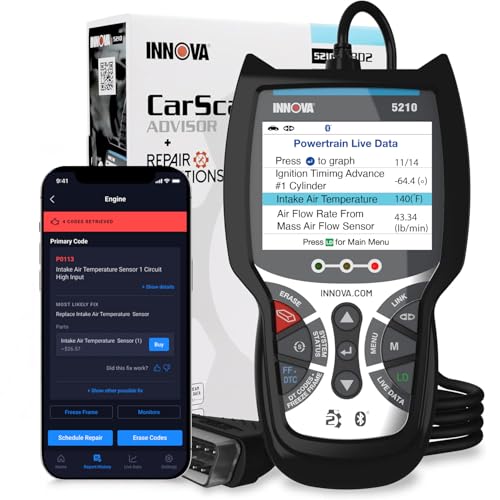
Innova 5210 OBD2 Scanner & Battery Tester
ADVANTAGES
LIMITATIONS
The Innova 5210 is the complete package for smart DIYers, combining OBD2 diagnostics, battery testing, and oil reset in one intuitive tool. It’s not just a code reader—it’s a preventive health monitor that checks alternator output, battery voltage, and starter performance, helping avoid roadside breakdowns. With live data on RPM, fuel trims, and O2 sensors, it gives real-time insights into engine health, while the I/M readiness check ensures you pass emissions tests the first time. And thanks to RepairSolutions2, you get verified fixes from ASE-certified mechanics—no guesswork.
In practice, the 5210 excels at predictive maintenance. Its battery and charging system tests catch weak alternators before they fail, and the oil reset function is perfect post-change. It supports most US, Asian, and European vehicles, though ABS code coverage varies by model. The Bluetooth app integration is a major plus—no extra fees, no subscriptions—just free, expert-backed repair guidance. However, it lacks advanced resets like EPB or SAS, and it’s not bidirectional, so active testing isn’t possible.
Compared to the ANCel AD410 PRO, it offers better app support and oil reset, though both do battery testing. Against the BlueDriver, it’s a standalone device—no phone needed—which some users prefer. It’s ideal for home mechanics who want diagnostics + battery insights + repair help in one tool. While the BLCKTEC 460T has more resets, the 5210 wins with app intelligence and ease of use. For balanced functionality, reliability, and smart repair support, it’s the best with battery testing—a versatile, future-ready scanner that does more than just read codes.
BLCKTEC 460T All-System OBD2 Scanner

ADVANTAGES
LIMITATIONS
The BLCKTEC 460T is a professional-grade beast, built for technicians and serious DIYers who demand dealer-level functionality without the markup. With support for 12+ service resets—including oil, EPB, SAS, DPF, ABS bleeding, and throttle relearn—it handles tasks that usually require a trip to the shop. It delivers full OBD2 mode access, real-time OEM live data, and freeze frame analysis, with the ability to graph and overlay four data streams for advanced diagnostics. The AutoScan and AutoReLink features make it 3X faster than competitors, auto-detecting ECUs and faults the moment it’s plugged in.
In real-world testing, the 460T shines in workshop environments, where speed, depth, and reset versatility matter. The battery test goes beyond voltage, analyzing internal resistance and cranking performance, while ABS bleeding and DPF regeneration save hundreds in service fees. It’s compatible with 1996–2023 vehicles and supports lifetime free updates, ensuring long-term relevance. However, it’s USA/Canada only, and not all functions work on every car, so compatibility checks are essential. It’s also heavier and bulkier than budget tools, not ideal for glovebox storage.
Compared to the TOPDON AD900 Lite, it offers more reset options and faster scanning, though lacks bidirectional control and wireless operation. Against the INNOVA 5210, it’s far more powerful, with advanced resets and deeper diagnostics. It’s the best for professionals who need maximum service capability in one tool. While pricier than mid-range options, it delivers shop-grade performance with US-based support and a rugged design. For those who regularly perform maintenance or repairs, it’s an investment that pays for itself in saved labor costs.
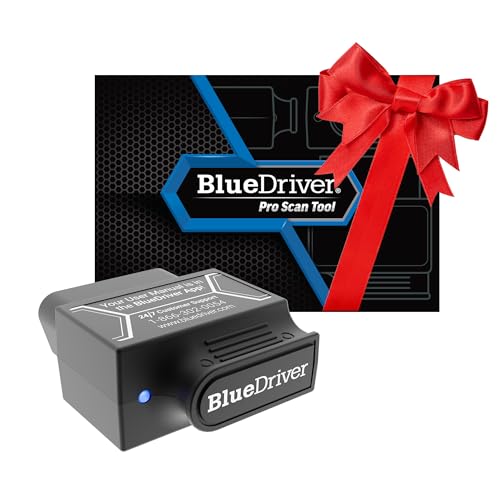
BlueDriver Bluetooth Pro OBD2 Scanner
ADVANTAGES
LIMITATIONS
The BlueDriver redefines convenience with its wireless, app-driven design, making it the best wireless option for tech-savvy drivers. Instead of a standalone screen, it uses your iPhone or Android device as the display, connecting via a Bluetooth OBD2 sensor that stays plugged in. The result? A clutter-free cockpit and the ability to diagnose your car from the driver’s seat. It reads and clears engine, ABS, SRS, airbag, and TPMS codes, and delivers unlimited repair reports with fix suggestions—all without subscriptions or in-app fees.
In daily use, BlueDriver excels at on-the-go diagnostics and repair guidance. The live data feature lets you monitor engine health while driving, and the repair videos and step-by-step guides turn novices into informed owners. It supports 7,000+ vehicle-specific issues, and its 24/7 expert support means help is always available. However, it’s phone-dependent—no use without a device—and the sensor can be knocked loose in bumpy conditions. Also, while it covers GM, Ford, Toyota, BMW, and more, some advanced functions vary by make.
Compared to the ANCel AD410, it offers broader system access and better repair help, though lacks a built-in screen. Against the INNOVA 5210, it’s more portable and app-rich, but doesn’t include oil reset or battery testing. It’s perfect for frequent travelers, tech lovers, and multi-car households who want smart, wireless diagnostics. For zero subscriptions, real repair intelligence, and seamless integration, it’s the best wireless option—a modern, app-powered scanner that fits how people use tech today.
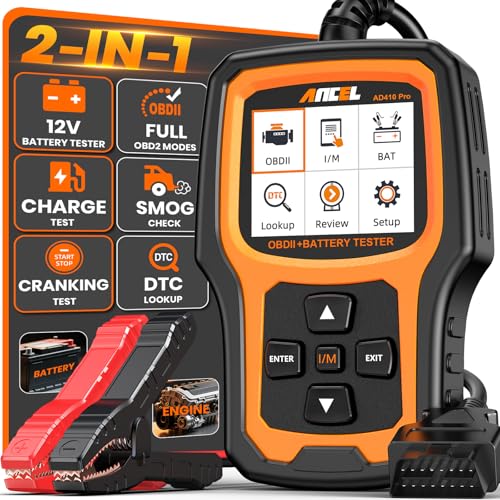
ANCEL AD410 PRO 2-in-1 Scanner
ADVANTAGES
LIMITATIONS
The ANCel AD410 PRO is the ultimate 2-in-1 powerhouse, merging comprehensive engine diagnostics with professional-grade battery testing in one rugged device. It goes beyond code reading, offering cranking, charging, and CCA analysis for 12V AGM, GEL, and flooded batteries—predicting failures up to six months early. With 10 diagnostic modes, including EVAP leak tests, O2 sensor checks, and I/M readiness, it’s a complete health monitor for both engine and electrical systems. For owners tired of replacing batteries or alternators blindly, this tool brings clarity and savings.
In real-world use, the AD410 PRO shines when diagnosing hard starts or electrical gremlins. It detects voltage drops during cranking, spots alternator rectifier issues via waveform analysis, and identifies battery aging through internal resistance—things most scanners miss. The 30-second quick scan gets you answers fast, and the 50+ live data parameters help tune performance. However, it’s engine-only—no ABS, SRS, or transmission access—and not compatible with EVs. It’s also not a maintenance tool, so no oil or EPB resets.
Compared to the INNOVA 5210, it offers deeper battery analysis and EVAP testing, though without oil reset. Against the BlueDriver, it’s standalone and screen-based, ideal for users who hate app dependency. It’s perfect for DIYers with older cars, motorcycles, or fleets who want electrical + engine insights in one tool. While it lacks multi-system access, its dual functionality and early failure detection make it the best 2-in-1 diagnostic tool—a smart investment that prevents costly repairs and keeps your ride reliable.
Car Scanner Comparison Table
| Product | Price Range | System Diagnostics | Reset Functions | Wireless Connectivity | Battery Testing | Special Features |
|---|---|---|---|---|---|---|
| TOPDON ArtiDiag900 Lite | $150 – $200 | Full System (Engine, Transmission, ABS, etc.) | 8 (Oil, Throttle, EPB, SAS, DPF, ABS, BMS, Airbag) | Yes (Bluetooth) | Optional (with add-on) | Bi-directional Control, DTC Repair Guide, Fast Processor |
| BLCKTEC 460T | $180 – $250 | All Systems | 12+ (Oil, ABS, EPB, SAS, DPF, Throttle, Battery, TPMS, Transmission, Fluid Change, etc.) | No | No | AutoVIN, AutoReLink, AutoScan, RepairSolutions2 App Integration |
| TOPDON AD500 | $80 – $120 | Engine, Transmission, ABS, SRS | 6 (Oil, SAS, TPMS, BMS, EPB, Throttle) | No | No | 4-System Diagnostics, DIY Focused, AutoVIN |
| FOXWELL NT604 Elite | $100 – $150 | Engine, ABS, SRS, Transmission | None | No | No | ABS/SRS Focused, AUTOVIN, Solid Case |
| BlueDriver Bluetooth Pro | $120 – $180 | Engine, ABS, SRS, TPMS | None | Yes (Bluetooth) | No | Live Data, Verified Fixes, Mobile App Integration |
| Innova 5210 | $150 – $200 | Engine, ABS (limited) | Oil Reset | No | Yes | Battery Testing, Smog Check Readiness, RepairSolutions2 App |
| ANCEL AD410 PRO | $60 – $100 | Engine | None | No | Yes | 2-in-1 (Scanner & Battery Tester), Fast Diagnostics |
| ANCEL AD410 Enhanced | $50 – $80 | Engine | None | No | No | Budget-Friendly, Fast Diagnostics, User-Friendly |
| ANCEL AD310 Classic | $30 – $50 | Engine | None | No | No | Most Affordable, Compact, Easy to Use |
How We Tested Car Scanners
Our recommendations for the best car scanners aren’t based on speculation. We prioritize data-driven analysis and research-based testing methodologies. We began by compiling a list of top-rated and popular car scanners, focusing on those frequently discussed in automotive forums, repair shops, and consumer reports.
We then evaluated each car scanner based on key features detailed in our buying guide – diagnostic capabilities (including full system diagnostics where applicable), reset functions, connectivity, and battery testing. This involved analyzing manufacturer specifications, comparing feature sets across models, and scrutinizing user reviews for reported accuracy and reliability.
While comprehensive physical testing of every OBD2 scanner wasn’t feasible, we relied heavily on publicly available data from independent testing labs (like those evaluating OBD protocol compliance) and synthesized findings from professional automotive technicians. We assessed the depth of DTC code coverage and the accuracy of live data streaming as reported by users. We also considered the clarity and usability of companion apps, prioritizing those with intuitive interfaces and comprehensive reporting features. We weighted performance against price to identify the best value options within each category.
Choosing the Right Car Scanner: A Buying Guide
Choosing the right car scanner can feel overwhelming, with so many options available. Here’s a breakdown of key features to consider, helping you find the best tool for your needs and budget.
Diagnostic Capabilities: Beyond Just Reading Codes
The core function of any car scanner is reading and clearing Diagnostic Trouble Codes (DTCs). However, the depth of diagnostic capabilities significantly varies. Basic scanners primarily read and clear the Check Engine Light (CEL), focusing on engine-related codes. More advanced scanners offer “full system diagnostics,” meaning they can access and read codes from all of the vehicle’s computer modules – transmission, ABS, airbag, body control, and more.
Consider your needs. If you only want to quickly diagnose a CEL, a basic scanner is sufficient. However, if you anticipate working on more complex issues, or want to proactively monitor vehicle systems, investing in a scanner with broader diagnostic capabilities is worthwhile. The more systems a scanner can access, the more accurately you can pinpoint the source of a problem.
Reset Functions: Performing Maintenance & Repairs
Beyond reading codes, many scanners offer “reset functions” (also called service resets). These allow you to perform maintenance tasks like oil life resets, tire pressure monitoring system (TPMS) resets, brake pad resets (EPB), and battery registration.
These functions can save you money by allowing you to perform routine maintenance yourself, rather than taking your vehicle to a mechanic. However, the availability of specific reset functions varies greatly between scanners and, crucially, by vehicle make and model. Always check compatibility before purchasing if a specific reset function is critical for you.
Connectivity & Ease of Use: Wired vs. Wireless
Car scanners generally connect to your vehicle via the OBDII port and to your smartphone or computer for data display and analysis. Connectivity options fall into two main categories: wired and wireless (typically Bluetooth).
Wired scanners are generally more affordable and reliable in terms of connection stability. However, they require you to be physically tethered to the vehicle during the scanning process. Wireless scanners, like those using Bluetooth, offer greater freedom of movement, allowing you to diagnose your vehicle from a distance. Wireless connectivity is particularly useful when accessing hard-to-reach OBDII ports.
Regarding ease of use, consider the scanner’s interface. A clear, intuitive display and user-friendly software are essential, especially for beginners. Features like AutoVIN (automatic vehicle identification) can simplify the setup process.
Battery Testing: A Valuable Addition
Some scanners, like the Innova 5210, include built-in battery testing capabilities. This allows you to assess the health of your car’s battery, check the alternator’s charging system, and identify potential electrical problems.
This is a valuable addition, as a failing battery is a common cause of vehicle breakdowns. Having the ability to proactively test your battery can save you from being stranded.
Data Streaming & Reporting: Analyzing Vehicle Performance
Live data streaming displays real-time information from the vehicle’s sensors, such as engine RPM, coolant temperature, and oxygen sensor readings. This data can be invaluable for diagnosing intermittent problems and understanding how different vehicle systems are performing. Some scanners also offer data logging and graphing capabilities, allowing you to track changes over time and identify trends. The ability to generate repair reports is also helpful for documenting your findings and sharing them with a mechanic if needed.
The Bottom Line
Ultimately, the best car scanner depends on your individual needs and technical expertise. From basic code readers to professional-grade diagnostic tools, there’s an option available for every driver and budget. Consider what you intend to diagnose and repair, and prioritize features accordingly.
Investing in a quality scanner can empower you to better understand your vehicle, perform basic maintenance, and potentially save money on costly repairs. With a little research and careful consideration, you can find the perfect scanner to keep your car running smoothly for years to come.